Choosing a ketamine clinic isn’t like picking a dentist. You’re comparing credentials on a website to select a place where your mind will enter an altered state. Where you’ll be vulnerable, open, and counting on someone else’s competence to keep you safe. In Portland, Oregon, where ketamine clinics have multiplied faster than regulators can track, the differences between exceptional care and corner-cutting are real, and they matter deeply.
This checklist isn’t theoretical. It’s built from the safety standards that governing bodies have codified, the research that tells us what works, and the hard-won lessons of patients who’ve handled this before you. Use it to sort the signal from the noise.
Does the Provider Have Proper Medical and Psychedelic Training?
Ketamine is a psychedelic treatment with profound effects on mood, perception, and cognition. The American Society of Anesthesiologists (ASA) released formal guidance in 2025 stating that ketamine “should only be prescribed and administered by trained health care professionals” and must form part of a comprehensive treatment plan.
This matters because clinics across the country now operate with strikingly different staffing models. Some are run by board-certified psychiatrists who evaluate your full mental health history. Others employ anesthesiologists or emergency medicine physicians who know how to manage vital signs but lack specialized training in psychiatric diagnosis. Still others are staffed by nurse practitioners or wellness providers with no in-house mental health expertise.
What to ask: “Who will actually evaluate my mental health before treatment, and what specific training do they have in psychiatric care?”
A quality clinic will answer without hedging. Empathy Grove, for instance, is led by Dr. Amy Kelchner, a licensed naturopathic physician with specialized training from the Integrative Psychiatry Institute and Polaris Insight Center, combining medical oversight with deep psychiatric awareness.
Is Someone With You the Entire Time?
The ASA guidance is unambiguous: IV and IM ketamine must be administered “only in a monitored setting with appropriate rescue equipment immediately available”. Yet not every clinic interprets “monitored” the same way. Some place a pulse oximeter on your finger and check on you periodically from another room. Other stations have a trained clinician at your side from the moment the medicine enters your body until you’re fully grounded again.
The difference matters clinically. Ketamine can cause transient spikes in blood pressure, episodes of anxiety or disorientation, and, rarely, more serious adverse events including respiratory depression.

When someone who knows you and understands your history is present, they can catch subtle shifts before they escalate. Equally important, they can offer reassurance during moments of psychological intensity, a hand to hold, a grounding voice, a reminder that you’re safe.
What to ask: “Will a trained practitioner remain with me for the entire session, or will I be left alone at any point?”
If the answer involves a call button or periodic check-ins, keep looking.
Do They Include Preparation and Integration, or Just the Infusion?
Ketamine opens a window of neuroplasticity, a period when the brain is unusually receptive to new learning and emotional reconsolidation. But a window is just an opening. What you do with it determines whether the experience becomes lasting change or a reprieve.
Research increasingly supports the value of what’s called ketamine-assisted therapy (KAT), which pairs the medicine with structured therapeutic support. A 2026 systematic review found that KAT, compared to therapy alone, was associated with “enhanced treatment engagement, symptom reduction, and duration of treatment response”.
Common factors of effective KAT protocols include:
- Preparation before the medicine session,
- Attentive supervision during the session, and
- Integration afterward.
In practice, this means quality clinics don’t just inject you and send you home. They meet with you beforehand to set intentions. They stay with you during the journey. And crucially, they schedule integration sessions afterward which give dedicated time to process what happened, translate insights into action, and solidify new neural pathways before the window closes.
At Empathy Grove, preparation and integration sessions are built into the treatment model, not offered as optional add-ons.
What to ask: “What preparation do you provide before a session, and how many integration sessions are included in your treatment protocol?”
What Does the Physical Environment Feel Like?
Set and setting are therapeutic variables with measurable impact on outcomes. Ketamine induces a dissociative state in which external stimuli can profoundly shape the internal experience. A cold, fluorescent-lit hallway with thin walls and ringing phones does not foster psychological safety. You need a space where your nervous system can let its guard down.
The best Portland ketamine therapy clinics treat the environment as part of the medicine. Look for private rooms rather than shared bays. Recliners or beds that invite you to settle in, not examination tables that signal medicalization. Soft lighting, weighted blankets, noise-canceling headphones, and nature-inspired design details that remind you you’re in a sanctuary, not a factory.
What to ask: “Can I see the treatment room before my first session?”
Any reputable clinic will say yes. If they won’t, that’s information.
What Safety Protocols Are in Place?
Safety before, during, and after the session isn’t a marketing bullet point. The ASA recommends that providers conduct thorough medical screening before ever prescribing ketamine, monitor vital signs throughout treatment, and ensure routine access to rescue personnel and emergency resuscitation equipment.
Best practices include: blood pressure checks every 20 minutes during treatment, pulse oximetry throughout, and a documented emergency transfer protocol. Clinics should also screen for contraindications:
- Uncontrolled hypertension,
- Certain cardiac conditions,
- A history of psychosis, or
- Concurrent use of medications that interact dangerously with ketamine.
What to ask: “Walk me through your emergency protocol and tell me what monitoring equipment you use.”
A clear, confident answer is reassuring. Vagueness is a red flag.
How Transparent Is Their Pricing?
Ketamine therapy is a significant financial hurdle, and ethical providers don’t hide the numbers. A single session in Portland, Oregon typically ranges from $500 to $800, depending on the route of administration and the level of therapeutic support. Some clinics require large prepaid packages; others allow you to pay per session.
Transparency matters because the lack of regulation in ketamine clinic operations means some providers blur costs or push aggressive upsells. You should know, before taking it on, exactly what each session costs and what’s included:
- Medical screening,
- Preparation,
- The session itself,
- Integration,
- Follow-up, and
- Whether there are additional fees beyond the quoted price.
Insurance rarely covers off-label IV or IM ketamine, however, at Empathy Grove, our ketamine costs can be offset by programs like Thank You Life and our in-house payment plans.
What to ask: “What is the all-in cost per session, and what does it include? Can I pay per session, or must I commit to a package up front?”
Do Past Patients Consistently Report Positive Experiences?
No clinic is perfect, but patterns in patient feedback tell you a lot. Look for recurring themes in Google reviews and third-party sites.
- Are patients reporting feeling safe and supported?
- Do they describe the staff as warm and competent?
- Or do patterns of rushed sessions, poor communication, or a transactional feel?
What to do: Read the clinic’s Google Business Profile reviews. Ignore the extremes (the delighted and the furious) and look for the consensus in the middle.
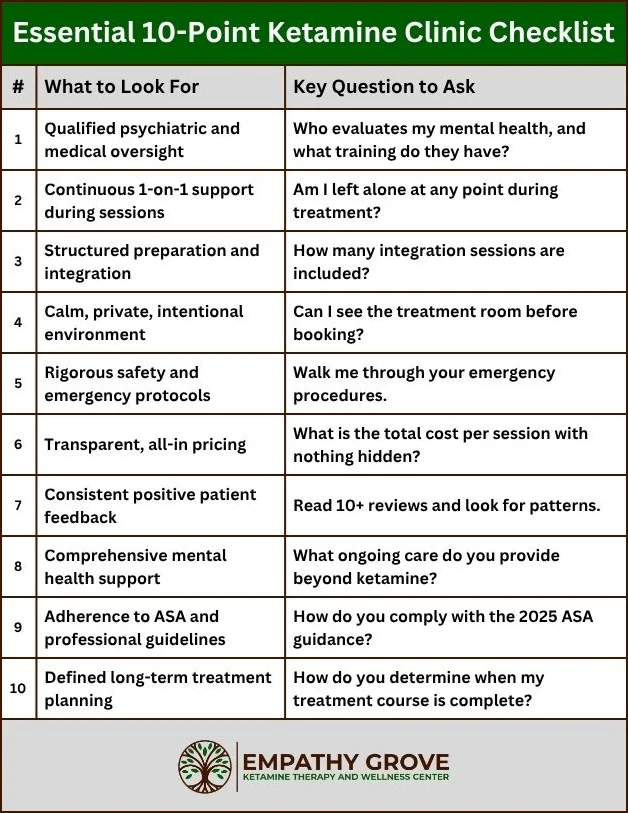
Your 10-Point Ketamine Clinic Checklist
Download this, save it, and bring it to your consultations. The right clinic will welcome every question.
Choosing a ketamine clinic in Portland shouldn’t feel like a gamble. When you know what separates excellent care from the rest, you can walk into your first session feeling something that might have been absent from your mental health journey for a long time: trust in the people holding the space.
Disclaimer: The content above is for educational purposes only and not a substitute for professional medical advice. Consult a qualified healthcare provider to determine if ketamine therapy is appropriate for you.