The landscape of mental health treatment is experiencing a renaissance, with psychedelic-assisted therapy emerging as a powerful tool for addressing treatment-resistant conditions. Most notably, ketamine therapy has become a popular treatment for its rapid effects on depression, anxiety, PTSD, complex trauma, and other mental health challenges. To understand why ketamine therapy can be so transformative, we can examine it through two complementary psychological frameworks: Kazimierz Dąbrowski’s Theory of Positive Disintegration (TPD) and Richard Schwartz’s Internal Family Systems (IFS) model. Together, these perspectives reveal how ketamine-assisted therapy facilitates profound psychological reorganization and healing.
Understanding Positive Disintegration Theory
Polish psychiatrist and psychologist Kazimierz Dąbrowski developed the Theory of Positive Disintegration (TPD) in the mid-20th century, challenging conventional views of mental health and development. Rather than viewing psychological crises as purely pathological, Dąbrowski proposed that emotional distress and the breakdown of existing psychological structures could be essential for growth toward higher levels of functioning.
The Five Levels of Development
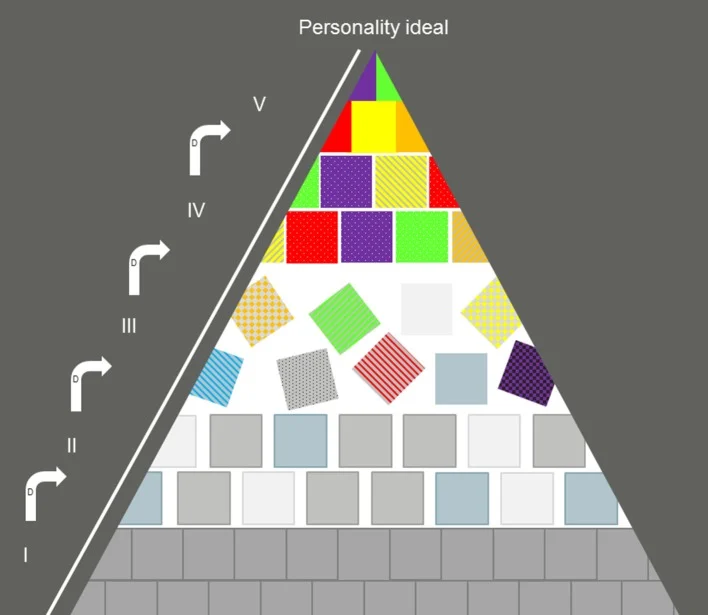
The Theory of Positive Disintegration describes personality development through five levels:
Level I: Primary Integration
A state of psychological unity based on biological drives, social conformity, and ego-centric functioning. The person operates with little internal conflict or self-reflection.
Level II: Unilevel Disintegration
The individual experiences internal conflict but lacks a clear hierarchy of values. They may oscillate between different impulses without a guiding principle for resolution.
Level III: Spontaneous Multilevel Disintegration
A crucial turning point where the person begins developing a hierarchy of values. They experience conflict between “lower” impulses and “higher” ideals, creating productive tension.
Level IV: Organized Multilevel Disintegration
The individual consciously works toward their ideal self, guided by autonomous values rather than external expectations.
Level V: Secondary Integration
A state of personality unity at a higher level, characterized by authentic self-expression, empathy, and alignment with universal human values.
Positive Disintegration as Growth
The “disintegration” Dąbrowski described isn’t breakdown in the pathological sense—it’s the necessary dissolution of rigid, limiting psychological structures that prevent authentic development. Anxiety, depression, and existential crisis can signal that outdated patterns are being challenged, creating space for more sophisticated psychological organization.
Internal Family Systems: A Map of Inner Multiplicity
Richard Schwartz’s Internal Family Systems (IFS) model offers a complementary framework that recognizes the natural multiplicity of the mind. Rather than viewing the psyche as a unified whole, IFS proposes that we contain multiple “parts,” or sub-personalities with their own perspectives, emotions, and intentions.
The Architecture of IFS
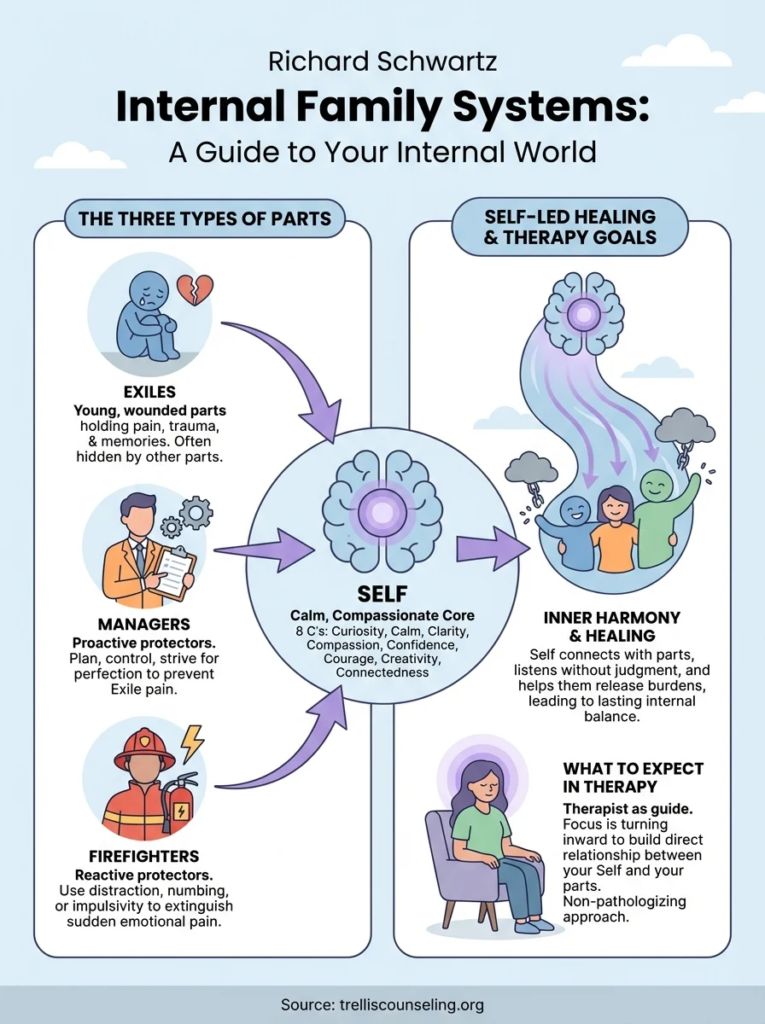
The Self
At the core of every person exists the Self—a compassionate, curious, calm, and confident center of consciousness. The Self is the natural leader of the internal system.
Managers
These protective parts work proactively to maintain control and prevent vulnerable feelings from emerging. They might manifest as perfectionism, intellectualization, caretaking, or controlling behaviors.
Exiles
These are young, wounded parts that carry burdens of trauma, shame, fear, or pain. Managers and Firefighters work to keep these parts hidden from consciousness.
Firefighters
When Exiles break through despite Managers’ efforts, Firefighters react impulsively to extinguish emotional pain through behaviors like substance use, self-harm, binge eating, or dissociation.
The Goal of IFS Therapy
IFS therapy aims to help clients access their Self and develop a compassionate relationship with all their parts. When the Self leads the internal system, parts can release their extreme roles and burdens, allowing for greater psychological flexibility and wellbeing.
The Convergence: How These Models Complement Each Other
Though developed independently, TPD and IFS offer remarkably compatible views of psychological development and healing:
- Both recognize that apparent pathology can serve development – Dąbrowski saw crisis as potentially positive; IFS views symptoms as protective parts doing their best to help.
- Both challenge the notion of a unified, static self – TPD describes transformation through levels; IFS maps the multiplicity within.
- Both emphasize values and authenticity – TPD’s higher levels involve autonomous values; IFS’s Self-leadership enables authentic living.
- Both view healing as reorganization rather than elimination – TPD describes reintegration at higher levels; IFS involves parts transforming their roles rather than disappearing.
Ketamine Therapy: A Catalyst for Transformation
Ketamine, originally developed as an anesthetic, has emerged as a breakthrough treatment for depression, anxiety, PTSD, and other conditions. Unlike traditional antidepressants that can take weeks to work, ketamine often produces rapid improvements. But beyond symptom relief, ketamine-assisted therapy can facilitate the deeper psychological reorganization described by both TPD and IFS.
Ketamine and Positive Disintegration
Ketamine therapy can be understood as facilitating movement through Dąbrowski’s levels:
Initiating Disintegration
For individuals stuck in Level I (rigid, defended patterns) or Level II (conflicted but directionless), ketamine can disrupt entrenched psychological structures. The altered state temporarily loosens rigid defenses and habitual thought patterns, creating space for new perspectives.
Facilitating Multilevel Awareness
During ketamine sessions, many patients report experiencing multiple perspectives simultaneously—observing their lives from different vantage points, connecting with deeper values, or encountering aspects of themselves previously hidden. This mirrors the multilevel awareness characteristic of Levels III and IV.
Supporting Reintegration
The neuroplastic window opened by ketamine (which can last days to weeks) provides an opportunity for new patterns to form. With proper therapeutic support, patients can integrate insights and reorganize their psychological structures at a higher level of functioning.
Accelerating Development
While Dąbrowski recognized that positive disintegration often occurs through life crises, ketamine therapy can potentially facilitate this process in a supported, intentional context, reducing unnecessary suffering while preserving the transformative potential of disintegration.
Ketamine and Internal Family Systems
The IFS framework offers particularly valuable guidance for ketamine-assisted therapy:
Accessing the Self
Many patients report that ketamine helps them access Self-energy, one’s experiencing themselves as calm, curious, compassionate, and connected. This state resembles what Schwartz describes as Self-leadership, where the person can observe their parts without being overwhelmed by them.
Meeting Protected Parts
The temporary softening of defenses during ketamine sessions can allow patients to become aware of Manager and Firefighter parts without triggering their usual protective responses. From Self-energy, patients can appreciate these parts’ protective intentions while recognizing their costs.
Connecting with Exiles
Perhaps most significantly, ketamine can facilitate safe connection with exiled parts carrying trauma and pain. The neurobiological effects of ketamine—including reduced amygdala reactivity and altered fear processing, and may allow patients to approach painful material that would typically trigger overwhelming distress or dissociation.
Unburdening
In IFS terms, “unburdening” refers to the process by which parts release the extreme beliefs and emotions they’ve carried. The combination of Self-access, reduced defensiveness, and enhanced neuroplasticity during ketamine therapy can create ideal conditions for unburdening.
System Reorganization
s Exiles are unburdened and protective parts relax their extreme roles, the entire internal system can reorganize with the Self in leadership. This mirrors Dąbrowski’s secondary integration—a new unity at a higher level of functioning.
Clinical Applications: Addressing Specific Conditions
Depression
Traditional Understanding: Depression involves persistent low mood, anhedonia, hopelessness, and often rigid negative thought patterns.
TPD Perspective: Depression may represent a disintegration process—the breakdown of inadequate psychological structures—but one that has stalled without progressing toward reintegration. The person is stuck in the painful space between levels.
IFS Perspective: Depression often involves Managers working overtime to suppress Exiles, leading to emotional numbness and disconnection. Alternatively, it may reflect Exiles overwhelming the system with hopelessness and despair.
Ketamine’s Role:
- Rapidly reduces depressive symptoms through neurobiological mechanisms
- Disrupts rigid negative thought patterns (facilitating disintegration of maladaptive structures)
- Enables access to Self-energy, allowing compassionate connection with depressed parts
- Creates neuroplastic opportunities for new, more adaptive patterns to form
- May help patients access meaning and values (supporting movement toward higher TPD levels)
Anxiety Disorders
Traditional Understanding: Excessive worry, fear, physiological arousal, and avoidance behaviors that interfere with functioning.
TPD Perspective: Anxiety can signal developmental tension—awareness of the gap between current functioning and potential. However, without proper channeling, it becomes overwhelming rather than motivating.
IFS Perspective: Anxiety typically involves Manager parts working desperately to prevent catastrophe and keep Exiles (often carrying early experiences of danger or inadequacy) from being triggered.
Ketamine’s Role:
- Reduces anxiety symptoms through effects on fear circuitry
- Allows patients to observe anxious parts from Self rather than being consumed by them
- Facilitates understanding of what anxious parts are trying to protect against
- Creates space for new responses to emerge beyond fight-flight-freeze
- Supports development of internal security (supporting higher-level reintegration)
Post-Traumatic Stress Disorder (PTSD)
Traditional Understanding: Intrusive memories, hypervigilance, avoidance, and negative alterations in mood and cognition following trauma exposure.
TPD Perspective: Trauma can shatter existing psychological structures (forced disintegration) without providing resources for reintegration, leaving the person fragmented and unable to move forward developmentally.
IFS Perspective: PTSD involves Exiles carrying extreme trauma burdens, with Managers and Firefighters working desperately to prevent these parts from overwhelming consciousness. This creates a rigid, constricted system.
Ketamine’s Role:
- Alters fear memory reconsolidation, potentially reducing traumatic memory intensity
- Enables patients to approach traumatic material while remaining in Self-energy
- Reduces hyperarousal and hypervigilance (calming protective parts)
- Facilitates processing and integration of traumatic experiences
- Supports reorganization of the system around Self-leadership rather than trauma-based protection
- Creates conditions for post-traumatic growth (movement to higher TPD levels through trauma integration)
Complex Trauma and Personality Patterns
Traditional Understanding: Pervasive patterns of emotional dysregulation, relationship difficulties, identity disturbance, and maladaptive coping stemming from chronic early trauma or adverse experiences.
TPD Perspective: Early trauma can arrest development at lower levels, with personality organization built around survival rather than authentic values. Rigid defenses prevent the disintegration necessary for growth.
IFS Perspective: Complex trauma typically involves multiple burdened Exiles, extreme protective parts, and difficulty accessing Self. The entire system is organized around managing trauma rather than living authentically.
Ketamine’s Role:
- Provides repeated opportunities to access Self despite heavy protective layers
- Allows gradual unburdening of multiple Exiles over a treatment series
- Supports development of internal safety and Self-trust
- Facilitates recognition of protective patterns without shame
- Creates neuroplastic windows for developing new relational templates
- Supports the extensive reorganization required for personality-level change
Substance Use Disorders
Traditional Understanding: Compulsive substance use despite negative consequences, often involving physiological dependence and psychological craving.
TPD Perspective: Substance use may represent an attempt to manage the pain of disintegration without progressing through it, or an escape from developmental tension. Recovery requires tolerating disintegration and moving toward authentic values.
IFS Perspective: Substance use typically involves Firefighter parts attempting to extinguish pain from Exiles, while Managers may alternate between controlling use and giving up. The substance itself can become a part of the system.
Ketamine’s Role:
- Reduces cravings through neurobiological mechanisms
- Provides alternative access to non-ordinary states previously sought through substances
- Enables connection with the pain underlying addiction (meeting Exiles)
- Facilitates understanding of protective functions of substance use
- Supports development of Self-leadership as alternative to substance-based coping
- May catalyze meaning-making and value clarification (supporting higher-level development)
The Therapeutic Process: Integrating Models in Practice
Preparation Phase
Effective ketamine-assisted therapy begins with thorough preparation:
Building the Therapeutic Relationship
At Empathy Grove, we achieve this by establishing trust and safety, recognizing our patients need support navigating vulnerable states. Ensuring patients feel physically and emotionally safe creates conditions for protective parts to relax enough for deeper work.

Education
Introducing relevant concepts from IFS (parts, Self, unburdening) and TPD (disintegration as potentially positive, developmental levels) provides a framework for making sense of experiences.
Setting Intentions
Helping patients clarify what they hope to address aligns with both IFS’s collaborative approach and TPD’s emphasis on conscious development toward values.
Dosing Sessions
During ketamine administration (at Empathy Grove, through intramuscular injection, or sublingual lozenges):
Facilitating Self-Access
The therapist helps the patient notice and rest in Self-energy, that calm, curious, compassionate awareness that can hold all experiences.
Supporting Parts Work
As different parts emerge (anxious managers, young exiles, reactive firefighters), the therapist guides the patient in relating to them from Self rather than being overwhelmed by them.
Holding Space for Disintegration
When patients experience confusion, dissolution of familiar patterns, or existential questioning, the therapist normalizes this as potentially positive disintegration rather than pathology.
Facilitating Insight
The altered state may bring new perspectives, connections, or awareness. The therapist helps patients notice and articulate these without forcing interpretation.
Tracking Reorganization
As the session progresses, the therapist watches for signs of new organization emerging—parts relaxing, Self-leadership strengthening, values clarifying.
Integration Phase
The period following ketamine administration is crucial:
Capturing Insights
Helping patients articulate and record their experiences while they’re still fresh.
Supporting Neuroplastic Consolidation
The days and weeks following ketamine involve enhanced neuroplasticity. Therapeutic work during this window can help consolidate new patterns.
Facilitating Continued Parts Work
Between ketamine sessions, ongoing IFS therapy helps maintain relationships with parts and continue unburdening processes.
Supporting Developmental Movement
Using the TPD framework, the therapist helps patients recognize and navigate developmental transitions, tolerating the discomfort of growth.
Addressing Challenges
When old patterns resurface or protective parts become frightened by changes, the therapist helps patients maintain Self-leadership and compassion.
Building New Structures
As old patterns disintegrate, supporting the development of new, more adaptive structures through behavioral changes, relationship shifts, and value-aligned actions.
Potential Challenges and Considerations
Not All Disintegration Is Positive
While Dąbrowski emphasized positive disintegration, not all psychological breakdown leads to growth. Ketamine therapy must be conducted with careful attention to:
- Adequate Support: Patients need sufficient ego strength and external support to navigate disintegration without becoming overwhelmed or destabilized.
- Proper Pacing: Moving too quickly can trigger extreme protective responses or retraumatization. The therapist must attune to the system’s readiness.
- Integration Resources: Disintegration without reintegration support can leave patients fragmented. Adequate integration therapy is essential.
Working with Protective Parts
Protective parts may resist ketamine therapy, viewing it as dangerous:
Respecting Protection
Rather than overriding protective parts, the IFS approach involves acknowledging their concerns and seeking their permission to proceed.
Building Internal Safety
Before deep work, ensuring that protective parts trust the Self to handle what emerges.
Addressing Backlash
When protective parts feel threatened by changes, addressing their concerns rather than pushing forward.
Spiritual and Existential Dimensions
Ketamine can facilitate profound spiritual or transpersonal experiences:
Holding Multiple Frameworks
Being able to work with spiritual experiences without imposing interpretation or dismissing them as “just” neurochemistry.
Existential Crisis
Movement to higher TPD levels often involves existential questioning. Therapists must be comfortable navigating questions of meaning, death, and authenticity.
Integration Challenges
Profound experiences must be integrated into daily life, which can be challenging.
Looking Forward
The convergence of Positive Disintegration Theory, Internal Family Systems, and ketamine-assisted therapy offers a powerful framework for understanding and facilitating deep psychological transformation. Rather than simply reducing symptoms, an integrated approach, like we specialize in at Empathy Grove, supports fundamental reorganization of personality toward greater authenticity, compassion, and alignment with values.
Dąbrowski’s recognition that crisis can catalyze development reframes psychological distress as potentially meaningful. IFS provides a detailed map of internal multiplicity and a compassionate methodology for working with all aspects of ourselves. Ketamine creates neurobiological and psychological conditions that can facilitate both the disintegration of limiting patterns and the reintegration at higher levels of functioning.
For individuals suffering from depression, anxiety, PTSD, and other conditions, this approach offers more than symptom relief, it provides a path toward becoming more fully themselves. The temporary dissolution of rigid structures during ketamine sessions, supported by IFS-informed therapy and understood through a developmental lens, can initiate profound and lasting change.
As we continue to explore the therapeutic potential of ketamine and other psychedelics, frameworks like TPD and IFS will be essential for maximizing their benefits while minimizing risks. These models remind us that healing isn’t about returning to a previous state or achieving a static endpoint—it’s an ongoing developmental process of becoming more integrated, authentic, and whole.
FAQs
1. How does ketamine therapy serve as a bridge between Positive Disintegration Theory and Internal Family Systems (IFS)?
Ketamine therapy facilitates inner psychological transformation by promoting disintegration and integration processes that align with IFS’ multiplicity and growth models.
2. What role does ketamine play in addressing depression within these frameworks?
Ketamine acts as a catalyst that supports the dissolution of entrenched negative patterns, enabling healthier parts to emerge and fostering overall psychological growth.
3. How does Positive Disintegration Theory conceptualize personal development?
It views growth as a process of disintegration and reintegration, where inner conflicts lead to higher levels of maturity and self-awareness.
4. Why is understanding internal multiplicity important in IFS?
Because recognizing and working with diverse inner parts allows for healing, integration, and the development of a coherent self.
5. In what way can ketamine therapy enhance the therapeutic process involving these models?
It provides a profound, often transformative experience that can soften defenses, allowing for deeper exploration and integration of inner parts and developmental stages.
–
Disclaimer: The content above is for educational purposes only and not a substitute for professional medical advice. Consult a qualified healthcare provider to determine if ketamine therapy is appropriate for you.